Sub-Total: $0
Did You Know???
Written by Genealogical Society volunteer Beth Mitchell for the Wilmington News Journal.
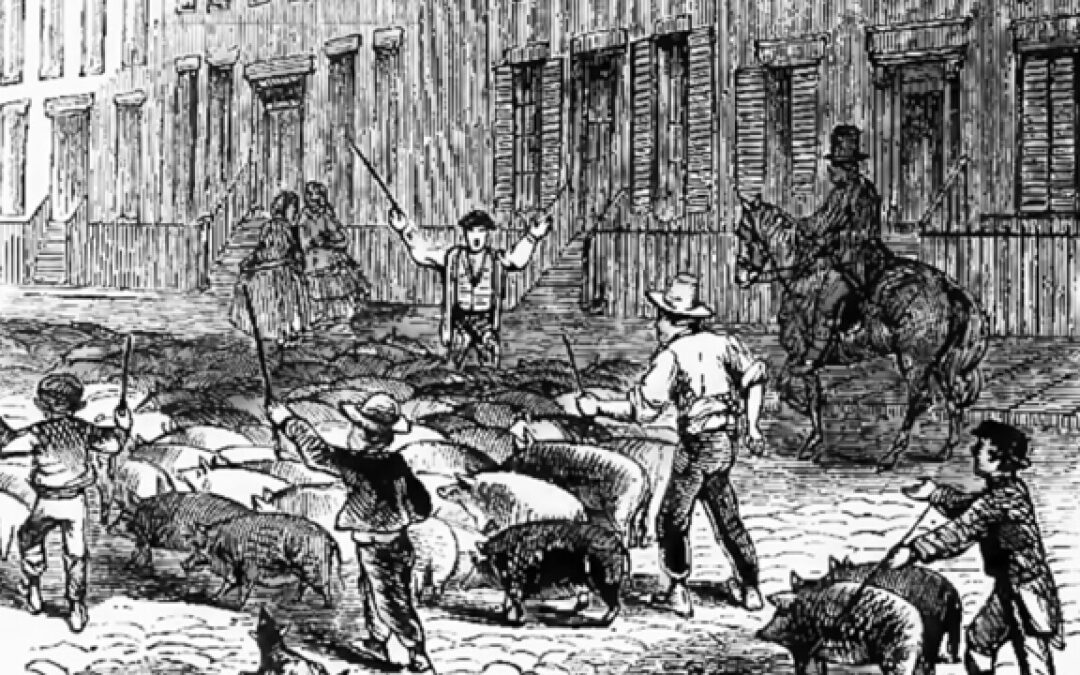
In the Clinton Republican published April 19, 1861 I found an unusual Sabina ordinance. Is it still on the books? Be it ordained by the Council of the Incorporated Village of Sabina that it shall be unlawful for the owner or owners of any hog or hogs to permit them to run at large within the corporate limits of the village and any person or persons offending shall be liable to the penalties provided. The Marshall shall take charge of all hogs running loose and attempt to find the owner. If the owner is not found, the Marshall shall sell them as provided by law. Any person found to own any of the hogs shall be charged a reasonable fee for keeping or taking care of them. The fee shall be collected by the Marshall.
There really were horse thieves. In the Clinton Republican published June 27, 1851 it reads: “On last Monday night, two fine young horses were stolen from the farm of Mr. Cornellius B. Bloom, about three miles East of Wilmington.” On Tuesday several neighbors started to search for the horses. On Wednesday Mr. John W. Laughead, one of the men in pursuit, notified authorities that he had possession of the horses and the thief. A man who had claimed to be Edward Jones was found to really be Elijah Metts. He was tried and convicted and sentenced to five years in the penitentiary.
In the Clinton Republican published February 7, 1851 the headline read: Port William Counterfeiters. According to the article the persons charged were David D. Adair and Peter Stephens. Adair used his father, James Adair, as his bail. A short time later warrants were issued for James Adair, Eli B. Smith, and Cyrus Johnson. Adair and Smith took off. Cyrus Johnson, the only one remaining, was examined before Esquire Sewell and his bail was set at $400.00.
Another bunch of counterfeiters!!! The article reads: On Thursday of last week two men calling themselves George Buchanan and Lewis Jenkins stopped in Bloomington. A small purchase was made and shortly after they left, it was determined that the bill was counterfeit. It was a ten-dollar bill on the State Bank of Ohio. A warrant was issued and the men were overtaken in Greene County where they were staying for the night. A warrant was obtained and when their pockets were searched it was found they had in their possession $480.00 of counterfeit money. “The scamps were brought back to this county, examined, and committed to jail to await the approaching Term of our Court.”
An ordinance was passed in Port William April 18, 1861 that prevented the sale of “spiritous or intoxicating liquors” within the corporation of Port William. Be it ordained by the Council of Port William that if any person shall sell, vend, or give away these products for any reason other than medicinal or mechanical purposes, they shall appear before the Mayor and be fined a sum of not more than $50.00 or less than $5.00 plus cost of prosecution and imprisoned in the County jail not exceeding ten days. No part of this ordinance shall be construed as to prevent any person from selling or giving wine for sacramental purposes.