Sub-Total: $0
About the Clinton County History Center
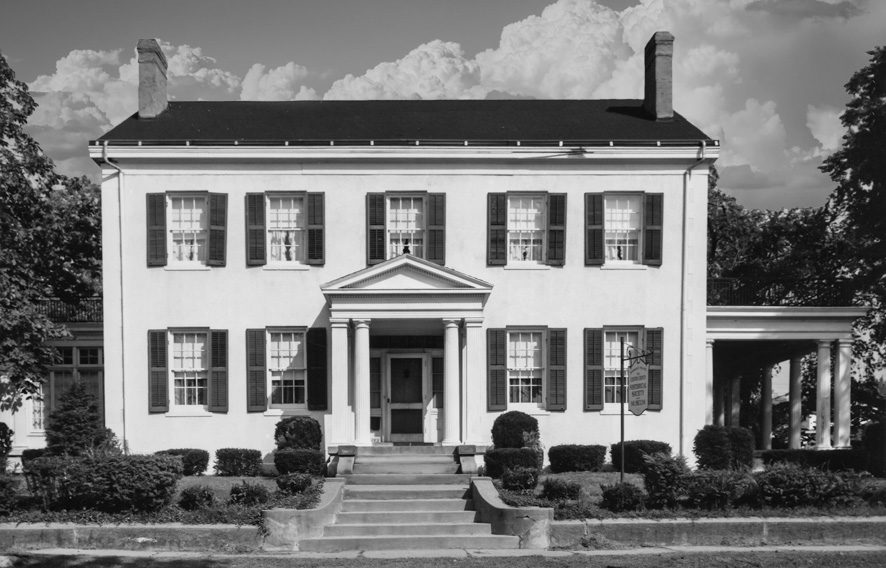
Chartered in 1948, the Clinton County Historical Society purchased its museum home in 1955. The site is listed on the National Register of Historic Places as the home of Brigadier General James W. Denver (for whom Denver, Colorado was named).
The History Center is a multi-function 501(c)3 facility operated privately by the Clinton County Historical and Genealogical Societies. We encourage anyone with an interest in Clinton County history – or family history research – to become a member of one or both societies. The Center includes:
- Touring museum with rotating exhibits and special displays
- Research library
- Manuscript, photographic, and reference archives
- Textile and artifact repositories
- Meeting and program space for educational and community use
- Administrative offices supporting History Center operations
Have Something to Donate?
We are grateful for donations that help preserve and share Clinton County’s story. Before you bring an item to the History Center, please review our donation guidelines and the types of historical materials we are able to accept.
Learn more about donating items → (https://clintoncountyhistory.org/before-you-donate-what-to-know/)
Have Something to Donate?
We are grateful for donations that help preserve and share Clinton County’s story. Before you bring an item to the History Center, please review our donation guidelines and the types of historical materials we are able to accept.
Learn more about donating items → (https://clintoncountyhistory.org/before-you-donate-what-to-know/)
Need an Appraisal?
The Clinton County History Center does not provide appraisals or assign monetary value to historical items. However, we are happy to recommend qualified local professional appraisers. Please contact us for recommendations.
Looking for a Historic Photo?
The History Center offers reproductions of vintage photographs from our archives for personal, educational, and creative use. If you’re not sure which image you need, we encourage you to schedule an appointment to browse with staff assistance.
Learn more about photo reproductions → (https://clintoncountyhistory.org/before-you-request-archival-photographs/)

General James W. Denver
A dedicated room of the museum features the personal library and artifacts of General James W. Denver – Civil War general, territorial governor, and national political figure.
Born in 1817 near Winchester, Virginia, Denver moved with his family to a farm near Wilmington in 1831. His career took him across the country and into major moments of 19th-century American history, including:
- Service in the Mexican-American War under Gen. Winfield Scott
- Travel to California during the Forty-niner Gold Rush
- Roles in California politics (State Senate, Secretary of State, and U.S. Congress)
- Appointment as Commissioner of Indian Affairs (1857)
- Service as Governor of Kansas Territory during “Bleeding Kansas”
- Civil War leadership as Brigadier General of federal troops in Kansas
- Later legal work in Washington, D.C., representing Native Americans in treaty-violation claims
Denver married Louise Catherine Rombach in 1855, and their home – Rombach Place – has served as the museum site for the Clinton County Historical Society since 1955. He is buried in the Denver Family plot at Sugar Grove Cemetery in Wilmington. Denver, Colorado was named in his honor during his service as Governor of the Kansas Territory.

Eli Harvey: Artist & Sculptor
Internationally known artist and sculptor Eli Harvey was born September 23, 1860, near Springfield Friends Meeting in Clinton County. He later lived and worked in Alhambra, California, befriended fellow painter and illustrator Normal Rockwell, and where he ultimately died on February 10, 1957. His ashes are buried in the Harvey family lot at Springfield Friends Cemetery.
Before his death, Harvey donated the majority of his life’s work to the Historical Society. Works displayed at Rombach Place include paintings and sculpture by Harvey – including a bronze copy of a bull elk, the symbol of the Order of Elks, commissioned in 1904.
Harvey is best known for animal sculpture. Notable credits include:
- Brown University’s “Brown Bear” mascot
- The C. Penney bull, created for merchant James C. Penney, founder of JCPenney stores
Decorative work for the lion house at the New York Zoological Park
Carl Moon: Photographer of the Southwest
Clinton County native Carl Moon was among the earliest photographers to document American Indian communities in their homelands. His photographs – many taken in the early 1900s – are featured within our Native American Heritage Exhibit.
Drawn to the Southwest by an abiding interest in Indigenous cultures, Moon and his wife traveled and photographed tribes primarily in Arizona, New Mexico, and Oklahoma, creating a lasting visual record. Carl’s works are also on display at major collection institutions such as the Smithsonian and J. Paul Getty Museum.
“Mr. Moon and I like to write about Indians and picture them because I think way down in our hearts, we almost wish we were Indians ourselves.”
– Grace Purdie Moon
The Textile Room
The Textile Room features Quaker (Society of Friends) quilts and coverlets. Quakers played a prominent role in Clinton County’s early settlement, and their influence continues today through active Quaker meetings across the county.
In 1870, the Society of Friends purchased the struggling Franklin College and established the Quaker college now known as Wilmington College.
Featured Artifact: Abolitionist Quilt (c. 1842)
One of the most significant items on display is an abolitionist quilt made by Quaker women in Clinton County and Newport, Indiana. Measuring about six feet square, each of its 16 blocks is signed by its maker.
While the quilt’s exact purpose is unknown, scholar Ricky Clark suggested in Piecework (July/August 1995) that it may have helped strengthen bonds between Friends meetings during the abolition separation of 1843. These women had been disowned by the mainstream Quaker meetings due to their anti-slavery activities. Although the Quakers were opposed to slavery, they did not want their members to take an active role in the emancipation movement. The women who made the quilt were all members of the Indiana Yearly Meeting of Anti-Slavery Friends, which consisted of twelve Monthly Meetings in Indiana and Ohio. Rebecca Harvey Hadley of Clinton County, who along with her daughters signed the quilt, was related to several of the signers from Indiana. By the later 1850s, the anti-slavery Quaker groups disbanded and rejoined the mainstream Quaker movement.
Native American Heritage Exhibit
This exhibit features arrowheads, projectile points, and prehistoric items found in Clinton County, Ohio, along with materials that help interpret the region’s earliest history and archaeology, before our official founding year of 1810.
Highlights include:
- A reproduction of the historic Wilmington Tablet
- Portraits by photographer and Clinton County native Carl Moon
- Prehistoric fossils and archaeology records by George Austin
A 10,000+ year-old woolly mammoth tusk, donated by the family of Lucile Fisher Hadley
School Days
Need copy...
Our Staff
-
Mark Huber
B3: Mark Huber, Archives Assistant Mark Huber became the sports editor of the Wilmington News Journal in 1987 after working at the newspaper since the late 1970s as a part-time sportswriter. While at the News Journal, he has served in various capacities, including editor, assistant editor, general assignment reporter and…
-
Molly Boatman
Molly Boatman, Volunteer Multimedia Specialist Earning her Associates Degree from the School of Advertising Art, now known as the Modern College of Design, Molly resides in Wilmington with her pet Chinchillas and currently operates her own freelance graphic design business. Passionate about art, graphics, and assisting non-profits, she generously donates…
-
Bev Beireis
Bev Beireis, Collections Manager Bev, a Clinton County native, grew up in New Vienna where her family owned and operated the “Daye Hardware Store” for 40 plus years. Bev graduated from East Clinton History School and attended the Cincinnati Christian University where she studied Business Administration and Deaf Education. Bev…
-
Shelby Boatman
Shelby Boatman, Executive Director Graduating from Wilmington High School, Shelby is a Clinton County native. Shelby earned her Bachelor of Arts Degree in History and Political Science from Ashland University and is an Ashbrook Scholar alumna, as well as a Gilder Lehrman Institute of American History scholar. Shelby later completed…
-
Darlene (Rogers) Kassner
Darlene (Rogers) Kassner grew up in Midland and Blanchester Ohio. She is a graduate of Blanchester High School and a graduate of Wilmington College with a degree in Elementary and Secondary Education. She received her Master’s Degree in Educational Administration from Xavier University. She was a sixth grade teacher in…
-
Mary Kay (McMillan) Vance
Mary Kay (McMillan) Vance was born and raised in Clinton County on the family’s Gurneyville Road farm. The McMillan ancestors settled in Chester Township in 1805 and the family still owns some of the original land along with the land grant signed by George Washington. Mary Kay is a graduate…



Giving Opportunities
The Clinton County Historical Society is a 501(c)(3) nonprofit organization. Donations are 100% tax-deductible, as allowed by law.
The Society relies on memberships, donations, bequests, memorials, admissions, tours, special events, and investment income to support operations and preservation work. Your gift helps care for collections, create exhibits, and provide educational resources for the community.
Ways to Give
B3: Annual Giving
Gifts to the Annual Giving Fund provide flexible, year-round support for the work of the History Center. Annual Giving may be directed by the Board toward a dedicated project or used for operating needs that sustain Rombach Place and our day-to-day public services.
Your contribution helps support priorities such as:
- Collections care and preservation supplies
- Educational materials for programs, tours, and community learning
- Exhibit preparation and installation
- Ongoing operating support that helps maintain the museum home and keep doors open to the public
Annual Giving is one of the most effective ways to strengthen long-term sustainability while responding to the most immediate needs of our organization.
Planned Giving
Planned giving offers meaningful ways to support Clinton County history while reflecting your long-term goals. If you are exploring a planned gift, we welcome the opportunity to meet with you and your professional advisor to discuss how your intentions can be documented and honored. While we cannot provide financial or legal advice, we are happy to coordinate with your counsel to ensure your wishes are clearly understood.
Bequests & Memorial Gifts
Bequests and memorial gifts can honor your passion for Clinton County history or recognize the life of a friend or loved one. No gift is too small. Please contact our office to discuss this opportunity with our Director.
Make a Tax-Deductible Gift
To give by check:
Make checks payable to Clinton County Historical Society and note your preferred designation on the memo line.
Mail to: P.O. Box 529, Wilmington, OH 45177
Questions? Please contact Executive Director Shelby Boatman at (937) 382-4684 or via email.